
| West-Indian Spurge |

|
 |

|


| File size | 799283 |
| Original date | 2/22/09 12:20 PM |
| Resolution | 2048 x 1536 |
| Flash | Flash did not fire, auto |
| Focal length | 82.8mm |
| Exposure time | 1/320s |
| Aperture | 5.6 |
| Focus Distance | |
| Metering Mode | Multi-segment |
| Camera make | Panasonic |
| Camera model | DMC-FZ18 |
| Sensor type | OneChipColorArea |
 |
 ative |
 |
 |
 |
Photo: |
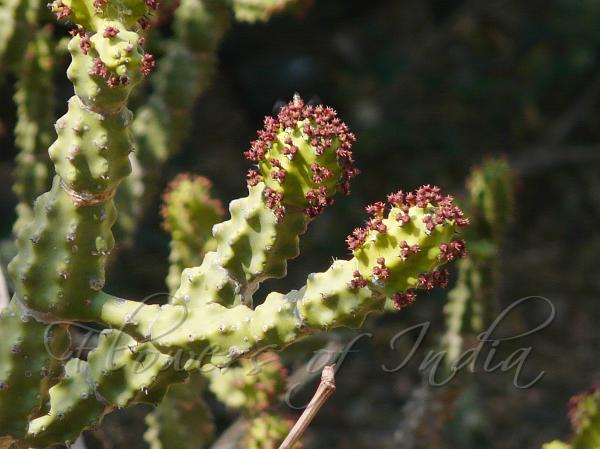
Botanical name: Euphorbia paschimia Family: Euphorbiaceae (Castor family)
Synonyms: Euphorbia neriifolia auct. mult. non Linnaeus
West-Indian Spurge is a densely branched, spreading
shrub 2-4 m tall, occasionally a small tree up to 6 m, with a sparse,
rounded crown. Bark is grey with persistent tubercles and branch scars.
Branches are vertically oriented, with short segments 5-20 cm long and
variegated new growth. Tubercles are prominent, 5-15 mm long, narrow,
flattened-sided and sub-confluent. Spine shields dark brown becoming
dark grey, circular, 5-6 mm across, bearing paired, divaricate spines
2-8 mm long. Leaves fleshy, crowded at branch tips,
inverted-lanceshaped, 6-8 x 2.5-3.5 cm, with entire, sometimes wavy
margins, blunt apiculate tips, wedge-shaped bases tapering into a 0.5
cm stalk, prominent midrib and faint lateral nerves; deciduous in the
dry season. Flowers are borne in solitary cymes, with deep red glands
and cup-shaped involucres 4-5 x 4-5 mm. Male flowers are in 5 fascicles
of 8-10; female flowers with 3-lobed ovaries. Capsules are red,
becoming pinkish to yellowish, triangular, 1-1.2 cm long; seeds nearly
spherical, brown, 2.5 mm across, without spots. West-Indian Spurge is
found in Western India, in Maharashtra, Daman & Diu, Karnataka,
Gujarat, Madhya Pradesh and probably Rajasthan.
| Identification credit: Dinesh Valke | Photographed in Mahuli, Maharashtra. |
• Is this flower misidentified? If yes,